Showing posts with label Injury Free Running. Show all posts

Monday, August 29, 2022

Returning From Running Injury


 The ankle mishap put a huge dent into my fitness. In fact it set me back to the start. In the first 3 weeks I could do no running and limited cycling and swimming. Nothing that maintained or improved my fitness. I use Training Peaks which I highly suggest to anyone and everyone who runs, rides or does multi sport. 

As of last Sunday my 42 day average stress score (a formula Training Peaks uses to measure the stress of the training taking into account the duration and the intensity) sat at 50. My 7 day average was 51. That simply means that I was fit for a normal human but not really fit to my standards and the 7 day average said I wasn`t doing anything to become more fit. 

The age old question is how to do you increase your fitness after injury to ensure you won`t set yourself back. 

This past week I did it this way: 

1. Recovery days were below the average or in this case below 50. 

2. General days were kept at the average. 

4. Improvement days were allowed to be free of constraint. 


The week looked like this. Total Stress 487

Monday: 31

Tuesday: 102

Wednesday: 52

Thursday: 66

Friday: 37

Saturday: 77

Sunday: 122 

My 7 day average is 56

My 42 day average is 51

To give some perspective, in December, January and part of February while gearing up for Ironman 70.3 Oman my weekly TSS was above 800. If I tried to execute an 800 Stress Score this week I would probably put to much strain on my ankle and quite possibly develop strain somewhere else. It is really boring to be this cautious and this specific but it will make sure I come out of this ankle thing stronger. 

Shoe of the Week 


New Balance Super Comp Trainer

My thinking for my ankle was that I needed stiffness and maximum cushioning in my running shoe. I bought this shoe for that reason. 

Highlights
1. 47MM in the heel and 39 MM in the forefoot. That will make you taller. 
2. Carbon Fiber propulsion plate that is specific to the stack height of this shoe. 
3. Fuel Cell foam which is resilient and alive on feel. 

The first 2-3 runs I was deciding whether I made the right choice. The shoe felt stiff and a bit firm for my ankle. Then all of the sudden it began to feel like butter. The midsole softened up and came alive. Running in it felt smooth and with that stack height and those other features there was no stress on my feet or ankles. 

If you are looking for a shoe to completely take the road out of the equation (don`t want to feel the road) this is a great option. 

Monday, August 8, 2022

Injury Recovery


 It took 3 weeks to recover from the heavy ankle sprain. It is the longest in recent memory I have had to hold off running. I started back 3 weeks to the day after the injury. I found that more flexibility in the shoe felt better than less. I managed 17 miles total for the week. My account of how I did it is below. 


Patience 

There is no other world that comes to mind. As a younger man that word did not exist. I am not sure you can have patience in all things when you are younger. Since my plan is to be running for years and years to come I know time off would not hurt me. Be patient. 

Don`t Rush 

Early on in the three I rushed to therapy. It only made the swelling and pain worse. So this is what I did. 

1. Started swimming right away. It was hard to swim with a stiff injured foot but it was not painful. 
2. As soon as I could put my foot into a bike shoe I got on the bike trainer and pedaled for 45 minutes every other day. I was not building or maintains fitness just moving the legs. 
3. One morning I woke up and my first step out of bed was not searing pain running up my leg. I gave it two more mornings to make sure it was real. Both of those days I stepped on the floor pain free. 
4. From there I started riding out doors. 

Swelling and Pain 

The swelling and movement pain continued. I would wake up in the morning with limited swelling and pain. Then both would grow through the day. That is when I started the actual work. 8 days out from my first run I started taking Aleeve. I kept it in my system 24 hours a day. In the evening I would soak my foot and ankle in an epsom salt bath. 6 days after that process the swelling was gone. Most importantly it would not come back during the day. I stuck with the protocol until that first run. 

Not 100% 

4 weeks into this the foot is still there. It doesn`t hurt much but I can always feel it. Never in my wildest dreams did I know how uneven our world is. Running down the road is treacherous. My left foot and ankle feel every divot and crack in the road. Stepping of or back on a curb requires thought. I must remain patient with my running for now. Never pushing the pace or the distance. 5 miles was my longest run last week, maybe it will be 6 this week. 

The morale of this story: 

Always wear a light when it is dark. 

Monday, July 18, 2022

Injured Runner


There are two types of running injuries. 

  • Stress Injuries - These are the most common. There are people just predisposed to running injuries and those who get their trading balance wrong by running too much at tempo or faster and not enough slow and easy. I personally can count on one hand the number of stress related injuries in my years of running. 
  • Impact Injuries - these are less common. Trail runners get them often when they hit a rock, root or anything else at an odd angle and hit the dirt. For me it takes two hands and maybe more to count the number times I have been injured this way. 
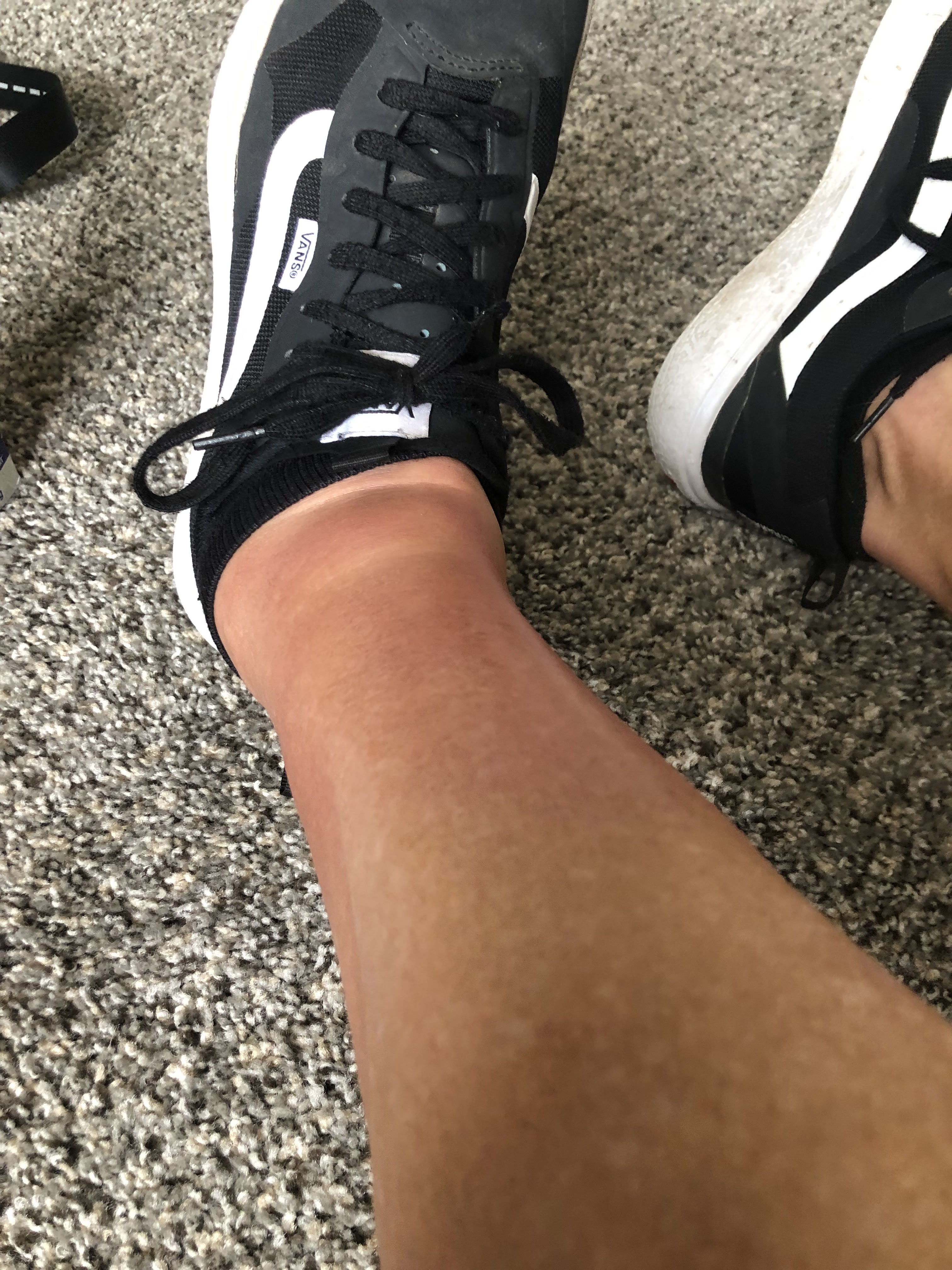
The picture shows my latest one. I was in Tennessee helping our son and his wife move to North Carolina. We had eaten dinner and watched a movie when my son said “Dad, do you want to go for a run?” By the time we got to the parking lot where we would run it was almost 9:30 pm. We headed out down a a bike path without lights (Next time I will choose to wear a light). The trail lead into the dense forest where it was just the two of us and the bugs that frequent the dark. We were having a glorious run, just chatting about life. We hit the turn around at close to 3 miles and headed back. There were two obstacles on the path. There was a bridge and at each end there was a poll in the middle ensuring nobody would drive a car on the bridge. That was it, stay in the middle of the path and all would be good until the polls. Early after the turn around I some how ended up on the left edge of the path. Without warning, my left foot hit the edge of the path which was raised 3-5 inches off the ground. My ankle gave way and like a rag doll I went down. 

I twist my ankle often enough to know I bend but rarely enough to hobble me. I got right up and started walking. My son told me not to rush it. I walked a bit and although I knew it wasn’t minor I started running. It felt ok over the final 2.8 miles but by the end of was throbbing really good. Aside from that I was bleeding down my right leg and left hand. Later I would find road rash on the front of my right hip. 

I was partially right on this one. I did bend and for sure did not break any thing and also did not snap any tendons or ligaments. What I did do was heavily strain the lateral side from my foot to just above the ankle bone. 

By Wednesday morning as I helped load the U Hall (that I drove to NC) my foot ankle and calf swelled to almost tripped their normal size. Over the next 4 days and we work driving and finally unloading the truck all I could do was manage the amount of swelling. 

Home now I can feel the healing process at work. In general I heal fast. Only time will tell how fast from this one. 

It was a dumb mistake on my part. That said I would not change a thing about it. The opportunity to run with my son far outweighs the pain in my ankle. If he asked me to run today with my ankle the way it is I would go. I am grateful every chance I have to run with him. 

Wednesday, July 6, 2022

Race Predictions


The other day I was texting back and forth with a friend of mine. He had just run a 10K race and won his age group. He made the standard comment “I started out way to fast” which I will cover later but one comment really struck me. He said “when I heard the split at 5K of 19:20 ish I thought I was running slow. The race predictor on my watch says I should be able to run 6:04 pace and I ran 6:19 pace” 

The above picture is from my Stryd foot pod. These race calculations are based on all of my recent training. To my knowledge it is basing these numbers off my critical power of 264 watts or 3.99 watts per KG. My 1 mile run would have to be run above that number to hit the time listed. My 5K would have to be run at that power for the entire 5K and so on down the road. 

Notes about Me

  1. The 3.99 watts per KG is kind of high. It is based on me being at race weight of 146. I am not there right now. The question would be should I go down the slippery slope of trying to get to race weight?
  2. Every predicted time on that list would be a new PR. I am fairly confident I could train specifically for one of those races (I have never trained specifically for any one of those events) and maybe I can set a new PR but those times I am not sure. 
  3. I don`t ever pay attention to these numbers. In fact I didn`t even know they were there until my buddy talked about his GPS Watch. 
My reply back to him was in three parts. 
  1. There is no way you could accurately track your mile splits on that course using GPS, you would have to use a Footpod to get more accuracy. The course he ran is on a bike path around a lake. The path follows the contours of the lake which almost looks like a leaf off an oak tree. Many virtual u turns and lots of short ups and downs. GPS would struggle to keep up. 
  2. Everything would have to be perfect on the day for you to hit that pace. You probably played Pickle Ball last night and there is a couple seconds per mile right there. I am not suggesting you don`t play pickle ball. 
  3. Starting too fast is a chronic problem of yours. You need to train that into yourself. Years ago I coached a friend to a PR in the marathon and a Boston BQ. She told me about her tendency to start fast. Once a week I had her do a medium length run 7 - 10 miles on an out and back trail. I have her a split at the turnaround and then a split for the finish. As we got closer to the event the run got a bit longer and the differential got a bit larger. So say we stated with 30 minutes out and 28 minutes back. Maybe we ended with 45 minutes out and 40 minutes back. The goal was to go out easy enough to be able to run back comfortably faster. She negative split her marathon and had a great race. 


Tuesday, April 21, 2020

Running with a Hernia


Leading up to the last weekend in February the talk in running was all about shoes. Should there be limits placed on what shoe companies make for the elite runners? Rules put in place for all shoe companies to follow. How much did Nike have a say in those rules? Then finally at the US Olympic Marathon trials Nike gave every entrant a pair of their new approved Nike Alpha Fly Next %. 

We are now sitting here on April 21st one day after the scheduled Boston Marathon (since moved to September 14th) and no scheduled running or triathlon races at least until June and probably long after June. The shoe discussion has been replaced by social distancing. 

In the world of social distancing my running is actually increasing. I’ve run 31 miles the last two weeks and will probably hit 35 this week. I’m not necessarily trying to run more miles I’m simply running faster these days. I didn’t say running fast just running faster. My 90 minute 10 mile run is now 11 miles. Well Sunday it was only 9.6 miles at that’s party because I the run at 1200 feet of climbing and a hernia. 

Yes, on Friday I was out walking the puppy. I was standing on a slight slope in the grass the puppy was running around with her best friend. Somehow they got behind me with me paying much attention. They charged into the back of my legs (when they are charging they are usually tangled up together). They hit me and I fell backwards down the hill. For the rest of Friday and Saturday it kind of felt like I got punched in the gut. I couldn’t remember getting hit in the gut so I ignored it. Sunday after struggling up the hills I took my shirt off and looked down. Their protruding out of my belly button was a hernia. Apparently the impact did it. 

I took Monday off, drank a ton of water and pushed the hernia back in. I woke up today with no pain but I called our health provider. They said as long as I wasn’t vomiting or doubling over in pain I could continue my activities. So, I went for a run. 

Monday, March 21, 2016

Barefoot Drills and Strides


It was kind of strange to hear my name called out on the Endurance Planet ATC Podcast. The question was from a woman who wants to get down to barefoot running. Tawnee mentioned my process of going out once a week doing drills and strides barefoot as a way to get used to barefoot running. I've been doing a great deal of research on runners recently. Asking them their process. How many runs a week, what kind of runs each week, how does running feel and what's hurting. In the running store most people are in a hurry and there's no time to do a full analysis but I always watch runners with a full analysis in mind. What I see and hear is a trend that I'm trying to undo.

Ask any runner who started the activity as a sport in school either on the track or in cross country and you'll here the same thing. Every workout or race started with a warm up, drills and strides and then the workout or race. Depending on the type of athlete especially track athlete the drills may be different and the amount and effort of the strides would be different but essentially that was the process.

Now ask any adult runner who didn't start in high school and most of them have no idea was running drills are. Then watch the runners like I do and you'll see form flaws that could be fixed by a regular dose of drills and strides. The biggest form flaws are lifestyle. People spend so much time sitting at the computer or with a phone in hand and the flaws look like they are still sitting at the computer.

Go to youtube and search running form drills.

Now the process is this:
1. Do the drills with perfect form - Relaxed shoulders, neutral head (absoloutely critical) that is looking out not down.
2. Speed of the drill is controlled by form. As soon as you look down or hunch your shoulders slow down. Form trumps speed.
3. Finish each drill set with a set of strides (4-10 strides) - 20 seconds in perfect form. I was taught to picture athletes. For the first half (2-3-4- or 5) of the stride set run like Edwin Moses for the second set run like Carl Lewis, Michael Johnson or Pick your sprinter. Recover fully which should be 30 seconds to a minute. You are not sprinting these you are using form to control. If form breaks slow down.

Now to the point of this. My goal for everyone is to get to as close to barefoot as possible in doing these drills. I've thought at length about this. What's more important, going barefoot or doing the strides? I think barefoot is more important. I see so many older people with foot problems I rank taking care of your feet above all else and the best way you can take care of your feet (in my opinion) is spend time barefoot on a soft surface. Everyone has a patch of grass close by. If you don't do drills and don't do strides at least go to that grass surface, take off your shoes and walk around. Once you are comfortable walking around, jog around. Once your comfortable jogging around start incorporating drills. Once you can do all the basic drills (high knees, butt kicks, AB skips, Carioka) then add strides slowly. Start with 4. when that becomes comfortable do 6. Get to 10. Put this process at the start or end of a run and you'll begin to undo all those lifestyle things than screw with your running form.

Barefoot Ted says barefoot running is a mindset. I fully agree with that idea. Once your mind clicks and you look forward to your once a week session in the grass you will begin to feel what natural running form is.

Tuesday, February 23, 2016

Sunday Long Run Then Rest

Sunday I went out for a run. Because of some mid morning commitments I ran early. I woke up at 5 and was running at 6am. We were out of coffee so I ran on a half a banana and water. 70 minutes into the run I felt like I was barely moving. I had a bottle with an electrolyte mix in it (no calories) and I had one Hammer Gel packet. I downed the Hammer Gel put my head down and started running. It was a hilly local trail run and I wanted to work the down hills. I ran the uphills telling myself to stay engaged in the hill and I ran the down hill open free and as fast as the hill allowed. The miles started to click off and before I knew it I had covered the same distance 12 minutes faster. The back half of the run was purely float state. It was enjoyable and it set me up for an outstanding day.


Wednesday, December 10, 2014

Are You Ready to Run?

If you search through my posts you'll get a pretty good idea of what I feel about running, running form and running shoes. After the first few times I went running I knew I wanted to run the rest of my life. Saying so and doing so are two very different things as most of you reading this understand. Injuries, children, jobs and general lifestyle all play a roll in our ability to run. But more than all of that is sheer pain. Running hurts. It hurts when you are out of shape trying to get into shape. It hurts if your 16 years old and taking a 3 week break between seasons. It hurts if you are 50 years old and have a lifetime of running.

Because of this I am always on the lookout for something to help me run as long as I can. Kelly Starrett wrote an encyclopedia for athletes when you wrote Becoming a Supple Leopard. I learned of his methods much earlier in his MobilityWOD YouTube videos. His delivery is spot on for me and I absorbed a ton. Once the book came out, I dug into it and have used it on a regular basis. I always felt that there was something missing. Well this year the missing peace came out in the form of Ready to Run.

I honestly believe if you run, you need this book. It doesn't matter if you are 15 or 50, make or female this book, if you use it as a running tool will keep you running pain free for a long time. Why?


  1. Proper Efficient Running form is everything to a runner. 
  2. Running Form starts in your head and works down to your feet. 
  3. Running Form does not start with your feet or more importantly what's on your feet. 
  4. If you allow your body to get tight, because of running, working at a computer, flying around the world (read through this blog) or sitting on the couch watching the NFL on Sunday, your running form will suffer.  
This book makes staying properly balanced easy to understand. The 12 tests you should be able to perform as a runner are not difficult. They are simple to execute and measure and if you can't do them the rest of the book is dedicated to getting you to be able to to them. 

I'll give you an example. 

For weeks now I've been dealing with pain that is all related: 
  1.  Low back pain
  2. Tight Hips
  3. Tight Hamstrings
Before I bought this book a couple weeks ago I was addressing the low back with a a foam roller and a lacrosse ball. Since I got the book this is my routine: 

  1. Voodoo Floss - Hamstrings - Essentially intense compression on each leg. I do this 3 times a day. 
  2. Baseball to my hips - I've had the same massage therapist for years. Whenever Dave got to my hips I'd tense up and it took him a good 20 minutes to work out the tightness. I always had tears in my eyes from the pain. Now with the baseball I can get to the exact same area and do it daily. 7 days or so into it, it's almost painless now. 
  3. Couch Stretch - I've always done this but now after the baseball it's so much easier to do. 
  4. Foam Roll my lower back. 
Results - Low Back pain is gone, hip movement is awesome and the hamstring tightness is slowly but surely leaving my body. 

The only issue I have with the book and it's minor is Standard #2: Flat Shoes

I believe flat shoes in your every day life is the right way to go. Try to convince my wife who likes to look professional in school and she'll say you're crazy but I believe in the Flat Shoes all day view. I however disagree with the Flat running shoes. Kelly talks about going from Motion Control shoes (Casts for your feet) to flat shoes. There are about 100 steps in that process before you ever can consider this. I firmly believe in running in the least amount of shoe you can get away with. If that means flat great. But most everyone in the running world will fall between the cast and flat. Very few ever need the cast and very few can run daily in flat shoes. 


Other than that one piece I think this book is a keeper and belongs on the book shelf of every runner on the planet. It's that good.

It's a good life....

.

Wednesday, March 26, 2014

No Foot Pain for Me

Everywhere I turn I'm confronted by runners in pain or injured. Yesterday in the office it was a knee. Saturday on the run it was shin pain. The weekend before it was a guy who was running in Newton for years and thought switching to a poorly created shoe that put him at a 13mm offset would be a good idea. The week before that it was three women running with pain and using Hoka running shoes to minimize the pain. 

There is stretching you should be doing but there is also self massage. Self massage has saved my legs and in my work below is what I've found to be the most important. 

 Today I'm going to focus on Foot and Achilles pain. What I have found is most of the pain is coming from tightness in the lower leg. To make sure I get at the tightness I use a Lacrosse Ball and a foam roller.
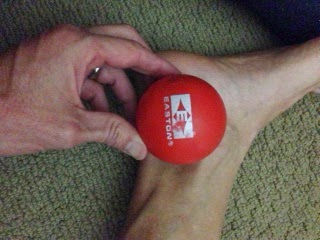
 One area that gets little love in stretching and standard self massage work is the Achilles itself. Walking, running, twisting all puts the Achilles under pressure. Too much and the area around it will get ultra tight. So using the ball I find the tight bits and then:
 I mash them. I roll up and down the groove between the muscle and the tendon and find the tight spots. The first time you do this you might cry but it gets easier the more often you do it.
 I also do the lateral side of the leg in the same place. You can do this at night and if you are really tight try it before you run. You will notice the difference.

I also use the ball to get to the top of calf and the hamstring attachment. Put the ball behind your knee, Use your hands to pull the shin in towards your butt. Move the ball around feeling for the tight spots. Believe me you have tight spots here and this hurts. Your legs will thank you when you are done.

 With the foam roller I roll my shins out using my body weight for the mash. If the last two didin't make you cry this one will. This is great because you can roll from the top of your foot all the way to your knee finding any part of that leg that is tight. Yes the picture is upside down but I think you understand. Put the roller on the floor. Put your shin on the roller with your bodyweight on top and roll.

I credit all of this the MobiltyWOD There is  a great deal more to this but for Running this is what I know works.

Now if you break your hand and can't run then hit the bike. This is Marco at 6:15am Monday morning hammering out. When the cast comes off there will be 2 or 3 track meets remaining in the season. Guess who wants to race them?

It's a good life….


Wednesday, July 3, 2013

Time: Take Time to Fix Your Body

This is the 604th Blog Post on this Blog. This may be the most important post ever. In the last 2 days I've talked to 10 runners or so. Virtually every conversation was about Injury. Not mine but theirs or at least someone they know. What makes me the magnet to all of these injured runners, I'm not sure but there is a history here. Not to long ago I worked at Road Runner Sports. In the late 90's or early 00's a magazine was started for the very large Run America Club. One of the Publishers (Bob Babbitt) asked me to host a column in the magazine that would be a Q & A. He said, "it will be great, they will send in questions about running shoes, and you'll answer them, we'll call you Super Dave." I was not super excited about the idea but I've always been proud of the fact that I'll do what it takes. So the magazine went out and the questions rolled in. But 70-80% of the questions had nothing to do with running shoes. They were all questions about running injuries. Using my spare time like I do here I researched every injury and tried to answer the questions. The feedback was amazing, people used what I said and liked it. I still have all the questions and answers and by the time the magazine stopped publication there were over 5,000 injury questions that had been answered. So although I'm not a doctor, a coach or anything but a shoe guy, I've got some experience with injured runners.

Here's what I found out:

  1. Running hurts runners - Running too fast, too soon, too long or too stupid injures runners. 
  2. Running shoes won't cure it - Not even those Moon looking running shoes that all the old guys are swearing by right now. Because of #1 even in those shoes Runners will get injured. 
  3. Once you are injured it sucks and it's hard to get rid of it. 
  4. The best way to stay injury free is run smart and spend the extra time on your body. 
The subject of this post is Take Time to Fix Your Body
Here's the short list.
  1. A good chiropractor
  2. A good Massage Therapist
  3. A good strength/balance trainer if your are not in balance
  4. Becoming a Supple Leopard
I was first introduced to Dr. Kelly Starrett on the internet. He does these great videos called MobilityWOD. I have written about them in the past. His belief that comes from years of working with athletes in his gym and around the world  is that if you spend 15 minutes a day working out the kinks you will become much more adept at doing the things you love. If you don't work out the kinks and spend time running too fast too soon, too long,and or  too stupid you will get injured. Just recently Kelly released a Book about all of this. Go to your local book store and buy it. It's the best $58 you'll spend on your running.

The book works like a home repair book. You find the body part that is stiff and let's face it you are a runner or a triathlete it's most of your body, and you'll find a description of your pain, a description of what you should really feel like and then a progression of work you can do on the stiffness. I have a standard set of parts of my body I work on. I've done it since I met MobilityWOD. But now almost daily I notice something else and I go to the book, look it up and add it to my routine. I also use many of the techniques before I run and swim. Especially on my feet. It works wonders to make those first 5 minutes of either effort so much nicer.

If this post helps one person stay injury free this year than it's been a wild success.